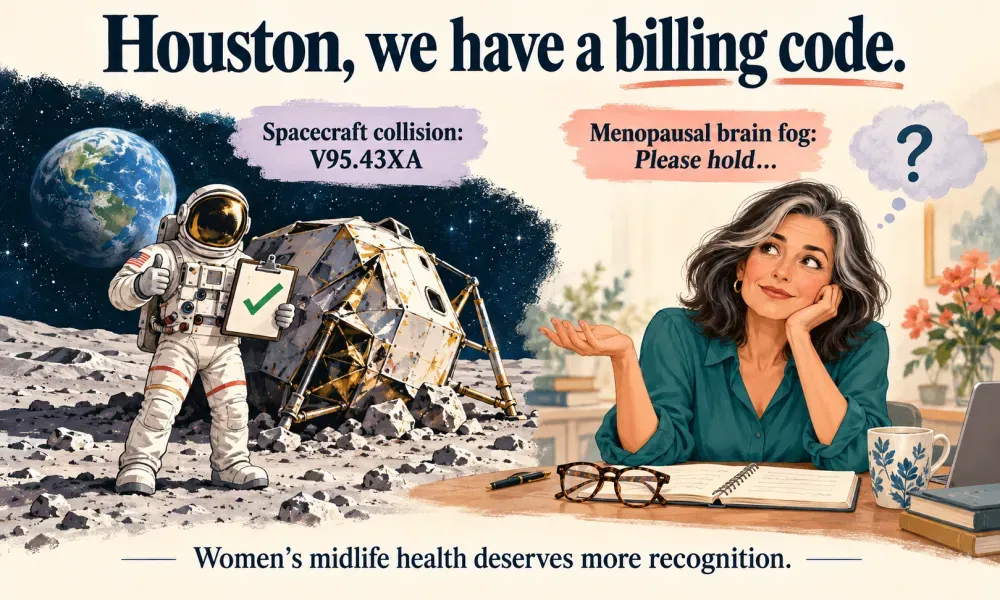
Spacecraft Collision? There’s a Code for That. Menopausal Brain Fog? Please Hold.
Nov 09, 2026
By Elaine Eustis, MD | Menopause Solutions, Mt. Pleasant, South Carolina
Imagine telling your doctor that you cannot sleep, cannot find familiar words, and cannot remember why you walked into the kitchen. Your joints ache. Your patience has relocated without leaving a forwarding address. You would like help figuring out whether perimenopause is involved.
Now imagine telling your doctor that you were injured in a spacecraft collision.
One of these situations has a remarkably specific place in the American medical coding system.
The spacecraft collision.
Welcome to the world of ICD-10 codes for menopausal symptoms, where an unfortunate encounter in outer space can receive a precise label while several symptoms affecting women during the menopause transition must squeeze into broader categories.
And the system does not stop at “spacecraft accident.” It would like to know whether you crashed, made a forced landing, or experienced an explosion. Apparently, even your rocket’s bad day deserves a detailed explanation.
In the United States, ICD-10-CM is the diagnosis classification system used in medical documentation and insurance claims. It translates medical conditions, symptoms, and circumstances into standardized codes.
Some of those circumstances are impressively specific. These are real descriptions in the current fiscal year 2027 code set:
| ICD-10-CM code | Official description |
|---|---|
| V95.43XA | Spacecraft collision injuring occupant, initial encounter |
| V95.42XA | Forced landing of spacecraft injuring occupant, initial encounter |
| V95.45XA | Spacecraft explosion injuring occupant, initial encounter |
| W59.22XA | Struck by turtle, initial encounter |
| W61.62XD | Struck by duck, subsequent encounter |
| V91.07XA | Burn due to water-skis on fire, initial encounter |
Water-skis. On fire.
Someone anticipated that clinical scenario and made room for it.
Meanwhile, a woman struggling to retrieve a common word during an important presentation has no dedicated code specifically identifying menopausal brain fog.
For anyone wondering, “initial encounter” refers to active treatment, rather than simply the first visit. Likewise, “subsequent encounter,” as in the duck example, generally refers to routine healing or recovery after active treatment. It does not mean the duck attacked twice. Although we cannot speak for the duck.
These unusual codes also describe external causes of injury. They generally supplement the actual injury diagnosis; they are not golden tickets to insurance payment. Their legitimate role is tracking how injuries happen.
Still, the contrast is hard to miss: we can distinguish a spacecraft collision from a forced landing with extraordinary precision, yet much of the menopause experience remains bundled into much less descriptive categories.
Before the coding professionals reach for their keyboards, an essential clarification: it would be inaccurate to say that menopause has no ICD-10 codes.
It does.
N95.1 identifies menopausal and female climacteric states. Other codes address conditions such as postmenopausal bleeding and postmenopausal atrophic vaginitis.
Symptoms such as insomnia, fatigue, cognitive complaints, and joint pain also have codes.
The gap is that several symptoms lack a dedicated code that identifies both the particular symptom and its relationship to menopause. Clinicians may use a broad menopause code, an appropriate symptom code, or a combination, depending on the documentation and coding rules.
Think of N95.1 as a large storage bin labeled “Menopause.”
Useful? Absolutely.
Specific enough to distinguish a woman’s cognitive difficulties from another woman’s sleep disruption or aching joints? Not by itself.
Apparently, the duck gets its own file folder. A substantial portion of midlife gets the communal bin.
You know the word. You have used the word for decades. You may even have a graduate degree involving the word.
Today, however, your brain has replaced it with: “You know. The thing. With the other thing.”
Memory and concentration changes are recognized features of the menopause transition. They can be distressing, especially when they interfere with work or make a normally confident woman question her abilities.
But there is no dedicated ICD-10-CM code titled “menopausal brain fog.”
A clinician may document the menopausal context and use applicable codes for cognitive symptoms. R41.89, for example, covers other symptoms and signs involving cognitive functions and awareness.
That is a broad category. It does not independently tell an insurer or researcher that the cognitive complaint occurred during the menopause transition.
The spacecraft codes distinguish a collision from a forced landing or an explosion.
But menopausal brain fog? Apparently, that remains harder to pin down than an actual rocket malfunction.
The brain-fog coding requires more explanation.
Which seems particularly unfair when explaining things is currently the problem.
Some women describe getting out of bed as an unexpectedly elaborate orthopedic event.
Yesterday, you stood up.
Today, there are sound effects.
Joint aches can occur around menopause, but there is no dedicated code specifically naming menopause-associated joint pain.
There are numerous codes for joint pain, including codes that specify the joint and side. That specificity is useful. What those codes do not necessarily capture is the clinician’s assessment that the symptoms are associated with the menopause transition.
The turtle, meanwhile, has been positively identified.
This is not an argument for blaming every aching knee on estrogen. Arthritis, injuries, inflammatory conditions, and other causes still deserve appropriate evaluation.
It is an argument that a clinically meaningful menopause connection should be easier to represent when it is supported by the assessment.
We should be able to acknowledge both the knee and the life stage without requiring a turtle witness statement.
You fall asleep exhausted.
Then, at 3:12 a.m., your brain convenes an emergency meeting.
Agenda items include tomorrow’s schedule, an awkward conversation from 1997, and whether the refrigerator is making a new noise.
Sleep problems are recognized during the menopause transition. Sometimes hot flashes and night sweats are involved; sometimes other sleep problems need investigation.
Insomnia has ICD-10-CM codes, and the broad menopause category encompasses menopausal sleeplessness. What is missing is a dedicated standalone code that specifically distinguishes menopause-related insomnia.
A symptom can therefore be recognized without its menopausal context being clearly visible in a single code.
Compare that with W61.62XD, which identifies care following an injury involving being struck by a duck.
The duck’s contribution to the medical situation is explicit.
The ovaries’ contribution may require a paragraph.
The humor becomes less amusing when the symptoms involve vaginal burning, painful sex, or urinary discomfort.
Genitourinary syndrome of menopause, or GSM, describes a collection of genital, sexual, and urinary changes associated with declining sex hormones. Existing codes can describe parts of that picture, including postmenopausal atrophic vaginitis and individual urinary or sexual symptoms.
But as of November 2026, the current ICD-10-CM code set does not contain a dedicated GSM code.
That is more than an editorial complaint. A proposal presented at the September 2026 ICD-10 Coordination and Maintenance Committee meeting specifically described how current coding fragments this syndrome into separate pieces. It proposed N95.81 for GSM.
A proposal is not an active code, and that proposed number should not be treated as currently available for billing.
The significance is that the gap has been formally identified. The proposal explains that a dedicated code could improve documentation, research, and tracking of care.
A syndrome affecting intimate comfort and urinary health deserves to be represented as a coherent medical condition.
Preferably with at least as much clarity as a spacecraft having a mechanical crisis.
Here is where we need to be precise: a missing menopause-specific code does not automatically mean a service is excluded from coverage. Having a code does not guarantee payment, either.
Insurance decisions also depend on the plan’s benefits, the treatment requested, medical necessity requirements, medication formularies, prior authorization rules, and other factors.
There is no universal rule that says, “Menopause code absent: deny everything.”
Nor does the existence of a turtle code mean an insurer enthusiastically pays every turtle-related bill.
The concern is that broad or fragmented coding can make the complete clinical picture harder to communicate. If brain fog appears as one symptom, insomnia as another, and joint pain as a third, their connection to the menopause transition may be much clearer in the clinical note than in the coded data.
That creates a reasonable concern about visibility. How readily can a system recognize the burden of menopause when its shorthand does not consistently capture the relationships clinicians and patients are discussing?
Better codes would not solve insurance coverage by themselves. They could, however, support clearer documentation and better measurement. Coverage policies would still need to recognize appropriate, evidence-based care.
The goal is not merely to give women a more attractive billing label. The goal is to make their medical needs easier to describe, study, and address.
Menopause is a normal biological transition.
So is aging. We still treat cataracts.
Calling menopause natural does not tell us whether a particular woman is sleeping, functioning at work, or having pain with intimacy. It does not determine how severe her symptoms are or which treatment is appropriate.
A normal life stage can involve symptoms that deserve medical evaluation and care.
Women should not have to present their distress as a series of unrelated malfunctions simply because the administrative vocabulary is less developed than the clinical conversation.
And they should not leave an appointment believing that a broad code means their experience is vague, trivial, or imaginary.
The code may be nonspecific.
The suffering often is not.
Bring concrete examples to your visit. Describe when symptoms began, how often they occur, and what they prevent you from doing.
“I’m tired” matters.
“I wake four times most nights and struggle to stay alert at work” gives your clinician a clearer picture.
Ask whether menopause could be contributing, while remaining open to other explanations. Not every midlife symptom is hormonal, and accurate diagnosis matters more than fitting everything into one category.
For insurance questions, ask your plan about the specific visit, medication, or treatment. If coverage is denied, request the written reason and information about the appeal process.
Your clinician’s documentation can describe the symptom burden and medical reasoning more fully than a code alone.
None of this should require becoming a part-time insurance investigator. Unfortunately, many patients already know where the hold music lives.
At Menopause Solutions in Mt. Pleasant, South Carolina, we take the concerns of women in Charleston and the surrounding Lowcountry seriously, including the ones that do not come with a perfectly tailored billing code.
Thoughtful menopause care begins with listening, evaluating symptoms, and discussing individualized options.
We need medical language—and coverage policies—that reflect the complexity of women’s midlife health.
Keep the turtle code. Keep the duck code. Track the flaming water-skis. And by all means, document what happened to the spacecraft.
But surely a system capable of distinguishing a spacecraft collision from a forced landing can make more room for a woman who simply wants to sleep, think clearly, move comfortably, and feel like herself again.
She should not need to leave the planet to get that level of specificity.
Code descriptions checked against the FY 2027 ICD-10-CM release, effective October 1, 2026. This article discusses gaps in dedicated menopause-specific coding; it does not suggest that these symptoms cannot be coded or that menopause care is universally excluded from insurance.
